Naps count toward daily sleep totals in babies and young children. Teenagers usually need 8–10 hours, while the adult recommendation of at least seven hours is not an exact target for everyone. Use age-based ranges alongside actual sleep, daytime functioning and a sleep record, rather than attributing short sleep, early waking or persistent sleepiness to age alone.
Does sleeping an hour less than an age chart recommends necessarily affect a child's development? Is seven hours enough for an adult who remains sleepy? Does waking before dawn mean that an older person needs only four or five hours? Age helps establish a useful starting range, but a chart alone cannot answer these questions. Assessing whether sleep is sufficient means considering actual sleep duration, how well someone sleeps, and how they function at school, work and home.
Separate time asleep, time in bed and naps
Recommended sleep duration means time actually spent asleep, not the entire interval between going to bed and getting up. Eight hours in bed is not eight hours of sleep if a substantial part is spent using a phone, waiting to fall asleep or lying awake. Estimate when you fall asleep and how long you are awake during the night; there is no need to keep checking the clock for minute-by-minute accuracy.
Recommendations for babies, children and teenagers usually refer to total sleep over 24 hours, including naps. Adult recommendations are often expressed as sleep per night. These figures help with everyday planning. They are neither a score for an individual night nor a boundary that diagnoses disease.
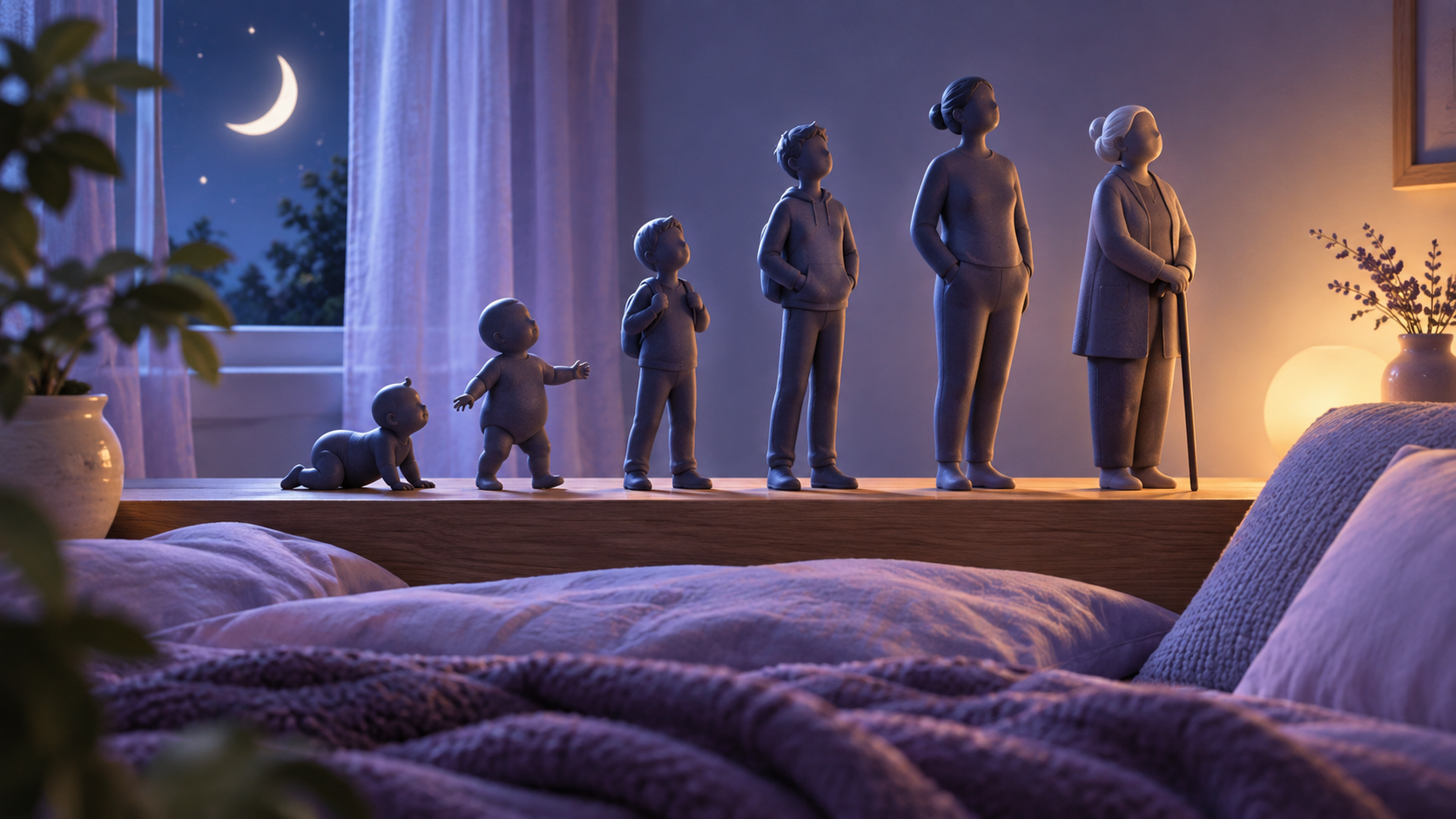
Babies and young children: count sleep across the whole day
- Birth to 3 months: 14–17 hours a day is a broad reference. Sleep duration and patterns vary widely in very young babies, so this is not a rigid target every baby must meet.
- 4–12 months: 12–16 hours a day, including naps.
- 1–2 years: 11–14 hours a day, including naps.
- 3–5 years: 10–13 hours a day, including any naps still needed.
For babies younger than four months, evidence linking an optimal sleep duration with health outcomes remains limited. The range for older babies should not simply be applied to them. Age bands are guides: sleep needs do not change suddenly on a birthday. Parents should also consider feeding, growth and responsiveness when awake. Premature babies, babies who are ill, and children with feeding or growth difficulties need an individual plan discussed with their pediatric clinician. Do not change a clinician's feeding plan simply to reach a sleep total.
Longer sleep must never come at the expense of safety. For every sleep, place babies under one year on their backs in their own infant sleep space on a firm, flat, level surface covered only by a properly fitted sheet. Keep pillows, loose bedding and toys out. When sharing a room with a caregiver, the baby should still have a separate sleep space.
School-age children: 9–12 hours, with attention to learning and mood
Children aged 6–12 usually need 9–12 hours of sleep a day. Work backward from the required wake-up time and allow room for getting ready for bed and falling asleep. Sleep should not simply be whatever time remains after homework is finished.
Children who lack sleep do not always just yawn. They may become unusually active, impulsive, irritable or inattentive. These behaviors have many possible causes and do not, on their own, diagnose insufficient sleep. When they occur alongside late bedtimes and difficulty waking in the morning, however, it is worth checking whether enough time is available for sleep. Acceptable grades or a child saying “I'm not sleepy” cannot establish that sleep is adequate.
Teenagers: 8–10 hours, even when sleepiness arrives later
Teenagers aged 13–18 usually need 8–10 hours of sleep a day. During puberty, the body clock often shifts later, making it natural to feel sleepy later in the evening and want to wake later in the morning. This does not necessarily reflect laziness. If school still requires an early start, the available nighttime sleep can be squeezed.
Families can review the time taken up by homework, travel and evening entertainment together, protect nighttime sleep and aim for a consistent routine. Naps count toward the daily total, but should not become a justification for routinely cutting nighttime sleep short. An 18-year-old sits at the overlap between adolescent and adult recommendations; a birthday is not a reason to abruptly lower the sleep target to seven hours.
Adults: seven hours is a recommended minimum, not an exact answer for everyone
Adults aged 18–60 should generally get at least seven hours each night on a regular basis. For ages 61–64, a commonly recommended range is 7–9 hours. “At least seven” does not mean that anything around seven is equivalent, or that seven is enough for every person. Health, daily rhythms and individual sleep needs all influence an appropriate schedule.
Young adults, people recovering from lost sleep and people who are ill may sometimes need more than nine hours. They should not automatically cut sleep short because they have exceeded a number. Conversely, feeling accustomed to five or six hours does not establish that it has no effect. Before attributing a short sleep duration to individual differences, check that there is sufficient opportunity to sleep and consider sustained alertness and functioning. Being busy and short of sleep is not evidence of naturally needing very little.
Older adults: earlier sleep and waking do not mean four or five hours is enough
A commonly used reference for adults aged 65 and over is 7–8 hours a day. This is not a rigid upper limit beyond which sleep is automatically a problem. Deep sleep may decrease with age, and sleep and wake times may move earlier. Someone who falls asleep early in the evening and feels well after waking early in the morning does not have insomnia simply because of the early wake-up time.
Record naps, nighttime wakefulness and actual time asleep separately. Then consider daytime dozing, changes in attention and any effect on everyday activities. Age cannot explain every change in sleep. A marked change from a previously stable pattern, or persistently short sleep accompanied by daytime sleepiness, warrants medical assessment rather than acceptance as an inevitable part of aging.
Use a record to understand your own needs and adjust your routine
- Start with the facts. Keep a record spanning school or work days and days off. Note bedtime, estimated sleep onset, awakenings, getting-up time and naps, along with caffeine, alcohol and medicines.
- Look at daytime functioning. Notice frequent unintended dozing in class, meetings or as a passenger, and changes in attention, mood or the ability to complete everyday tasks. Avoid drawing conclusions from the instant you wake up or from a single day.
- Check the opportunity to sleep. If work, homework or entertainment repeatedly takes up that time, make room for sleep first. Keep waking times reasonably consistent, reduce evening caffeine and alcohol, and allow a quiet transition before bed.
- Look for a pattern over time. An occasional short or long night does not require a label. Much longer weekend sleep can prompt a review of weekday sleep, but is not a diagnosis by itself. Persistent sleepiness after adjustments cannot be addressed simply by spending ever more time in bed.
When professional assessment is needed
Consult a clinician if repeated difficulty falling asleep, frequent awakenings or early waking continues to affect daytime life, or if substantial sleepiness remains despite an apparently adequate duration. Loud snoring with gasping, breathing pauses witnessed by another person, and uncontrollable dozing also need assessment. Sleeping within an age-based range does not rule out a sleep disorder.
Do not drive or operate hazardous equipment when sleepy. Bring your sleep record and a list of current medicines to the appointment to help distinguish insufficient opportunity to sleep, scheduling problems and other possible causes. An appropriate personal sleep plan draws on age-based guidance, everyday functioning and professional assessment when needed.
Health information noticeThis article provides general health education and does not replace professional diagnosis, treatment or personalized advice about medicines. Do not start, stop or change medicines or treatment based solely on this article. Seek medical care for persistent symptoms and urgent help for emergency warning signs. Images are AI-generated illustrations, not real patient photographs, clinical test results or evidence of treatment outcomes.
Copyright and rights concernsIf you believe any text or image in this article infringes your rights, please contact this website at we@worldsleep.com and provide the article link, a description of the concern and supporting rights documentation. We will review the information and respond promptly.